English

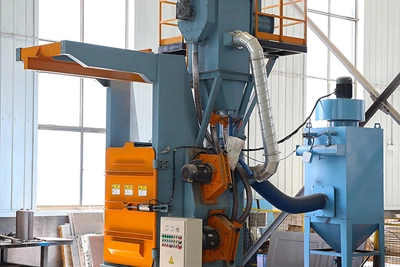
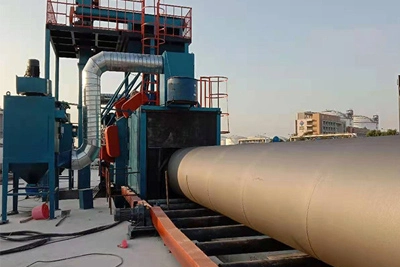
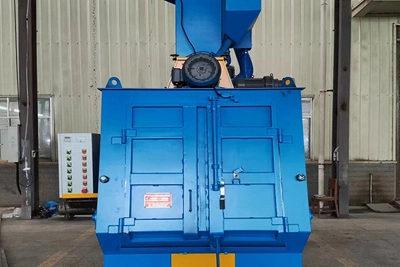
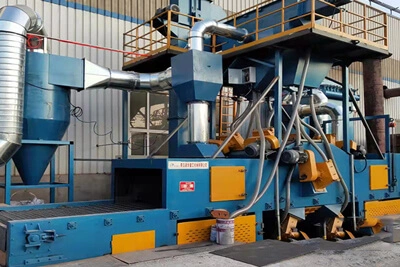

If you're choosing between a Double Hook Shot Blasting Machine and a Single Hook Shot Blasting Machine, the core difference comes down to workpiece throughput and productivity. A double hook system has two hanging points that allow one piece to be blasted while the other is being loaded/unloaded — effectively reducing downtime and increasing production capacity compared to a single hook design.
Below, I'll break down what that means in practical terms for your operations, performance, and cost considerations — from an industry expert's perspective.
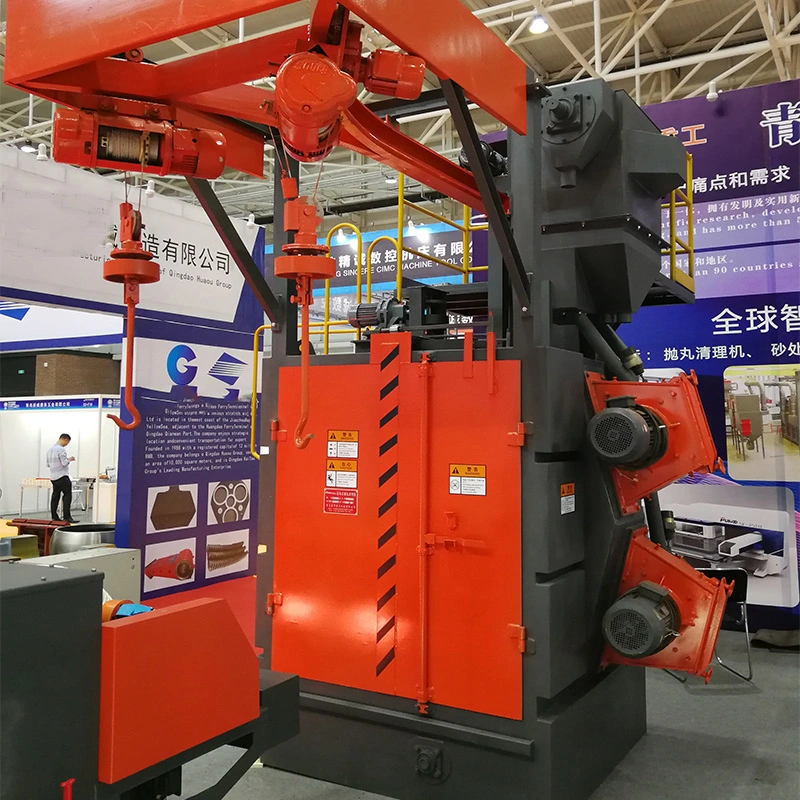
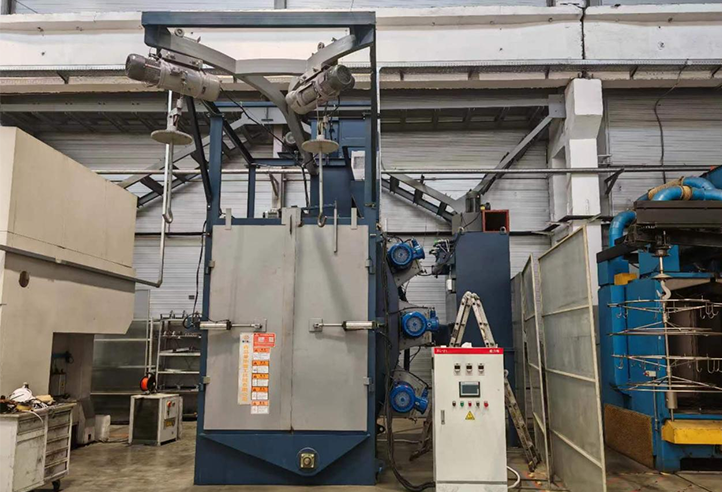
Hook shot blasting machines are a subset of hanger-type shot blasting systems where workpieces are suspended on hooks that travel into a blasting chamber. They are widely used for desanding, derusting, descaling, deburring, and surface strengthening of metal parts like castings, forgings, weldments, and heat-treated components.
Both single and double hook variants share this basic working principle, but differ in workflow efficiency and handling strategy.
Double Hook Shot Blasting Machine
Uses two hooks that work alternately — one is inside the blasting chamber while the other is being loaded or unloaded. This overlap in operations significantly reduces idle time and boosts throughput per hour.
Single Hook Shot Blasting Machine
Has only one hook, so blasting must stop while the piece is loaded or unloaded. This creates a cycle break and reduces overall hourly productivity.
Expert Insight: For high-mix, high-volume production, the double hook arrangement yields a clear productivity advantage — especially in continuous production lines.
Double hook systems facilitate semi-automated workflows. With two hooks moving in tandem along overhead rails, operators can stage incoming and outgoing parts concurrently.
Single hook systems require each part to fully complete the blasting process before the next can be loaded — which adds manual handling time.
Why This Matters: In automated or lean production flows, double hooks reduce handling bottlenecks.
Cycle time is a crux metric in surface treatment applications.
Double Hook: Shorter effective cycle due to overlapping tasks — when one hook is blasting, the other is ready to go.
Single Hook: Longer cycles because loading/unloading happens sequentially.
This makes the double hook option especially attractive for busy fabrication shops and contract manufacturers.
A frequent misconception is that double hook machines take more space. In reality:
Designs are often more compact because the system can be engineered as a continuous overhead rail without the need for larger ground footprint.
No pit foundation is typically required for either type in modern designs, saving installation cost and complexity.
Capital Cost:
Double hook models usually have a higher upfront cost due to more complex mechanics and control systems.
Return on Investment:
In operations where labor cost, floor throughput, and turnaround times are key KPIs, the productivity uplift from a double hook setup often outweighs the premium cost — especially in high-volume environments.
Expert Tip: Calculate ROI not just on machine cost, but on total throughput value per shift.
Here's how to think about choosing between the two:
| Application Scenario | Best Choice |
High-volume cleaning of medium-sized parts | Double Hook |
Job shop with variable batch sizes | Depends (if throughput is a priority, double hook; if variability is high and volumes low, single hook may suffice) |
Continuous production line | Double Hook |
Budget constrained with low throughput requirement | Single Hook |
Q: Is a double hook shot blasting machine faster than a single hook machine?
A: Yes — because dual hooks allow one workpiece to be blasted while the next is staged, reducing idle time and increasing throughput.
Q: Can a double hook system handle larger workpieces than a single hook system?
A: The hook count doesn't directly determine size capacity — that's governed by chamber dimensions and load capacity. However, handling efficiency improves with double hooks in applications where parts are similar in size.
Q: Does a double hook machine require a pit foundation?
A: Modern double hook shot blasting machines are commonly designed without pit foundations to save cost and simplify installation.
Q: Which is more cost-effective long term — single or double hook?
A: For high throughput operations, the double hook model typically delivers better ROI due to improved productivity and reduced cycle time.
As an SEO specialist and industry expert in shot blasting and surface treatment equipment, my recommendation is straightforward:
Choose a Double Hook Shot Blasting Machine if your operation values production efficiency, reduced cycle time, and high throughput. These systems are engineered to optimize workflow and lower unit blasting costs over time.
For smaller shops or low-volume requirements, a single hook machine may be more cost-efficient upfront — but be prepared for longer cycle times and lower hourly capacity.